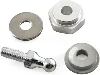
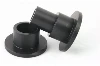
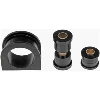
In modern vehicle chassis design, the Suspension Bushing plays a critical role as an interface component between the suspension arms and the vehicle body. It serves to isolate vibration, damp impact forces, and support controlled movement of suspension elements. By absorbing road irregularities and reducing noise transmission, a well-designed Suspension Bushing significantly enhances ride comfort and driving stability.
The material properties of a suspension bushing directly affect vehicle dynamics. Traditional rubber bushings offer excellent vibration isolation and a smooth ride quality, while polyurethane versions provide superior wear resistance, improved responsiveness, and greater durability under high-load conditions. The selection between rubber and polyurethane Suspension Bushing components depends on specific vehicle requirements, such as load capacity, performance expectations, and targeted NVH (Noise, Vibration, and Harshness) levels.
In dynamic driving scenarios - such as cornering at speed or towing heavy loads - the performance characteristics of the Suspension Bushing become even more relevant. A high-quality bushing must maintain dimensional stability and elasticity to prevent metal-to-metal contact between suspension parts, which could otherwise accelerate wear and reduce handling precision. This is especially important in vehicles designed for long-
distance touring, commercial use, or rougher road surfaces.
Beyond material choice, geometric design and manufacturing precision also influence how effectively Suspension Bushing elements perform. Consistent production tolerances ensure uniform load distribution and reliable fitment, helping maintain alignment and reduce premature degradation. Improved manufacturing processes and quality control, including APQP (Advanced Product Quality Planning) and IPQC (In-Process Quality Control), contribute to longer service life and more predictable performance of suspension components.
Finally, advances in automotive engineering are increasingly pushing Suspension Bushing design toward integration with lightweight chassis structures and active suspension systems. By reducing unsprung mass and optimizing compliance characteristics, engineers can achieve better fuel efficiency, improved handling balance, and refined comfort without sacrificing safety.
In summary, the Suspension Bushing is much more than a simple mechanical insert. Its performance affects vehicle ride quality, durability, and overall dynamic response. Understanding the role, material implications, and design considerations for Suspension Bushing components is essential for both automotive engineers and aftermarket service professionals alike.