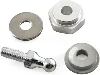
Mold Guide Pin Functions and Classifications
Mold guide pins are a crucial component of the mold. Their primary function is to secure the mold plate and ensure stability during operation. Depending on their application and functional requirements, mold guide pins are categorized into straight-through guide pins, position-limited guide pins, and pneumatic guide pins.
Mold Guide Pin Material Selection
Common mold guide pin materials include ordinary carbon structural steel, alloy structural steel, and stainless steel. Different materials have different properties and applications.
1. Ordinary Carbon Structural Steel
Ordinary carbon structural steel refers to structural steel with a carbon content of no more than 0.25%. It exhibits high strength and wear resistance. It is widely used in low-load, small, and medium-sized molds. Its hardness is generally around HRC 28-32.
2. Alloy Structural Steel
Alloy structural steel refers to structural steel whose properties are enhanced by the addition of alloying elements. It exhibits high strength, hardness, and corrosion resistance. It is commonly used in large molds with demanding requirements. Its hardness is generally around HRC 35-50.
3. Stainless Steel
Stainless steel offers excellent properties such as corrosion resistance and wear resistance. It is commonly used in high-end molds. Its hardness is generally around HRC 30-40.
Selecting the Hardness of Mold Guide Pins
The hardness of mold guide pins depends on factors such as usage conditions, working environment, and material selection. Generally speaking, too low a hardness can lead to deformation and wear, while too high a hardness can cause breakage and cracking. Generally speaking, the hardness of guide pins should be between 70% and 85% of the material's hardness. The selection should also be based on specific considerations, such as the mold's lifespan, usage conditions, and production cycle.